
NOVO-111 in Colorectal Cancer: Translating Selective Platinum Delivery into Durable Survival
Executive Summary
Colorectal cancer (CRC) remains one of the most consequential malignancies worldwide, with approximately 1.9 million new cases and more than 900,000 deaths annually. Despite substantial advances in targeted therapies and immunotherapy, cytotoxic chemotherapy remains foundational to the treatment of CRC. Oxaliplatin, most commonly administered as part of FOLFOX, is embedded across the treatment continuum and has contributed meaningfully to improvements in disease control and survival. Its therapeutic potential, however, is constrained by a fundamental pharmacologic limitation: the systemic exposure required to achieve meaningful tumor concentrations also produces cumulative toxicity, particularly peripheral neuropathy, which can necessitate dose reduction, treatment interruption, or discontinuation.
NOVO-111, INNOVOTEX’s lead Macrocycle Drug Conjugate (MDC), is designed to address this limitation by re-engineering the distribution, retention, and activation of platinum rather than replacing its established cytotoxic mechanism. NOVO-111 combines a tumor-localizing texaphyrin macrocycle with an oxaliplatin(IV) prodrug designed for intracellular reduction to active Pt(II) oxaliplatin (Figure 1). The development hypothesis is that preferential tumor localization and cellular retention can increase effective platinum exposure within malignant tissue while limiting pharmacologically relevant systemic exposure, thereby widening the therapeutic index of a clinically validated chemotherapy.
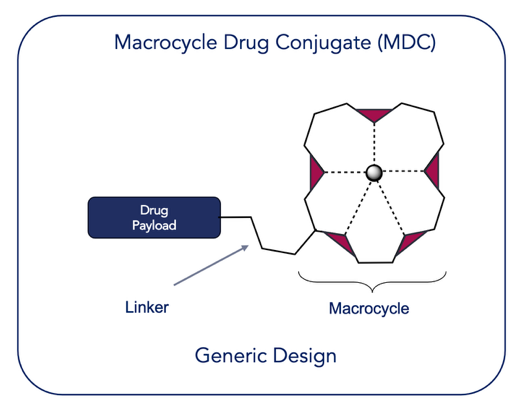
Figure 1. Generic illustration of a Macrocycle Drug Conjugate (MDC). These assets, containing a macrocycle designed to exploit altered cancer metabolism as a mechanism for intracellular uptake and retention, deliver validated drug payloads that are covalently attached to the macrocycle.
The significance of this strategy is most clearly reflected in NOVO-111’s preclinical survival data. In comparative CRC models, approximately 88% of animals treated with NOVO-111 survived beyond 80 days, compared with approximately 25% of animals treated with conventional oxaliplatin (Figure 2). This marked survival separation is particularly important because survival represents an integrated measure of therapeutic performance. Tumor growth inhibition establishes antitumor activity; pharmacokinetics characterize exposure; biodistribution defines where the drug accumulates; and tolerability establishes the boundaries within which treatment can be administered. Survival reflects the cumulative consequence of these parameters and provides a critical indication of whether improved pharmacology meaningfully alters the trajectory of disease.
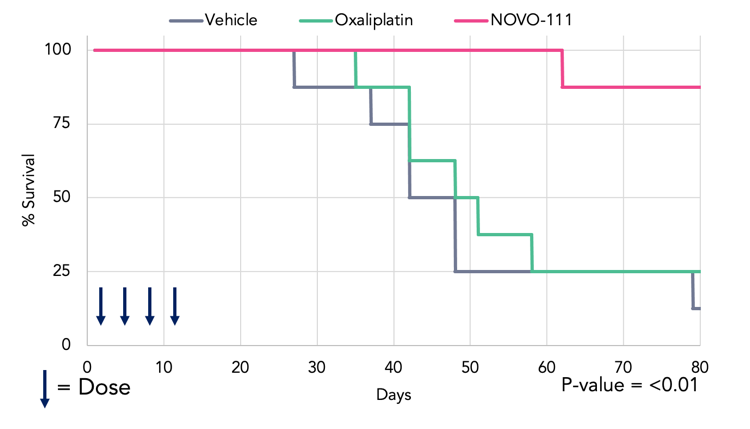
Figure 2. Survival of mice bearing colorectal patient derived xenografts treated with NOVO-111, oxaliplatin or vehicle. Study results illustrate a significant increase in overall survival with NOVO-111 treatment relative to non-responsive oxaliplatin.
The survival signal is supported by a coherent pharmacologic and efficacy profile. Preclinical studies have demonstrated approximately 6-fold greater intratumoral platinum concentrations with NOVO-111 relative to conventional oxaliplatin which has been found to overwhelm both pharmacologic and mechanistic barriers to overcome platinum resistance. In CRC models, this differentiated distribution has translated into greater than 90% tumor growth inhibition and significantly reduced systemic exposure in safety studies (Figure 3). Taken together, these findings suggest a mechanistic continuum in which increased tumor-selective platinum exposure produces deeper and more durable tumor control, ultimately contributing to prolonged survival.
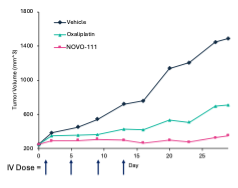
Figure 3. Efficacy study of Stage IV, right sided colorectal PDX models in mice treated with NOVO-111 and compared to oxaliplatin. While oxaliplatin provided a modest (50-60%) response, treatment with NOVO-111 resulted in compelling (>90%) tumor growth inhibition with no adverse safety effects.
This relationship is central to the NOVO-111 therapeutic thesis. Conventional oxaliplatin distributes platinum broadly, intrinsically coupling antitumor exposure with normal-tissue exposure. As cumulative systemic exposure increases, so too does the risk of toxicity. NOVO-111 is designed to disrupt this relationship. By preferentially localizing within tumor tissue, undergoing cellular retention, and enabling intracellular activation of platinum, NOVO-111 seeks to create a greater differential between tumor and systemic exposure. The objective is therefore not simply to deliver more platinum, but to increase the proportion of pharmacologically meaningful exposure occurring where it can contribute to tumor control.
Importantly, the magnitude of tumor exposure and efficacy observed with NOVO-111 has not been accompanied by a proportional increase in preclinical toxicity. NOVO-111 has demonstrated tolerability at platinum-equivalent exposures exceeding those achievable with conventional oxaliplatin, including tolerability at greater than four-fold platinum-equivalent dosing in preclinical studies. Moreover, preclinical models have not demonstrated the neuropathic pain phenotype associated with conventional oxaliplatin. Although these findings require confirmation through formal toxicology and clinical evaluation, their relationship to the survival data is important. A wider therapeutic index creates the potential not only for improved tolerability, but for sustained therapeutic pressure through greater effective tumor exposure without a corresponding increase in dose-limiting systemic toxicity.
The resulting pharmacologic profile – increased intratumoral platinum exposure, profound tumor growth inhibition, reduced systemic platinum exposure, improved tolerability, and prolonged survival—provides an integrated rationale for advancing NOVO-111 in CRC. Rather than viewing these findings as independent attributes, they represent interconnected components of the same therapeutic hypothesis: altering the disposition of platinum may change the balance between efficacy and toxicity sufficiently to affect survival.
This approach is particularly relevant in CRC because NOVO-111 does not require the creation of an entirely new treatment paradigm. Oxaliplatin’s mechanism and clinical relevance are already well established. The opportunity is to improve the performance of that mechanism. In this context, NOVO-111 can be evaluated as a potential next-generation platinum therapy designed to preserve the antitumor utility of oxaliplatin while addressing the pharmacologic constraints that limit its therapeutic potential.
The preclinical survival findings provide an important early indication of what such an improvement could mean. Approximately 88% survival beyond 80 days with NOVO-111 compared with 25% with conventional oxaliplatin suggests that the consequences of selective delivery may extend beyond short-term tumor response to durable disease control. The accompanying biodistribution and tumor growth inhibition data provide a mechanistic foundation for that observation, while the tolerability profile suggests that increased antitumor exposure may be achieved without proportionally increasing systemic toxicity.
NOVO-111 therefore represents a broader proposition for chemotherapy innovation. The next generation of cytotoxic therapy may not require abandoning proven mechanisms in favor of entirely new targets. Meaningful therapeutic advances may also be achieved by engineering where an established drug accumulates, how long it remains within malignant tissue, and how selectively its active payload is released.
For colorectal cancer, the central question is ultimately one of survival. If the tumor-selective pharmacology and survival advantage observed preclinically translate into patients, NOVO-111 has the potential to redefine the therapeutic index of platinum chemotherapy – not by changing what platinum does, but by changing where and how effectively it does it.